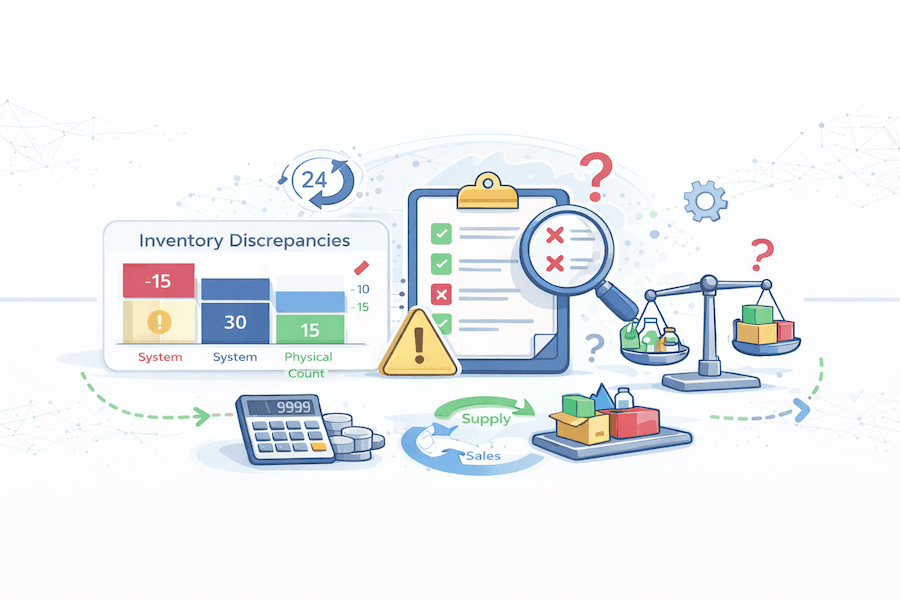
Sales sees 200 units and promises delivery. The warehouse warns that part of that quantity is already separated. Finance wants to know which cost layer will leave on the next shipment.
If one number is expected to answer all three questions, the operation starts making bad decisions before the balance even looks wrong.
Modern inventory systems solve this by separating stock positions and recording each event at the right moment. Physical stock, reserved stock, available stock, receipts, shipments, and FIFO cost layers do not mean the same thing. Once those distinctions are explicit, inventory becomes easier to allocate, receive, consume, and cost correctly.
Physical stock, reserved stock, and available stock answer different questions
A modern inventory system does not treat stock as a single quantity with one meaning. It treats inventory as a group of related positions.
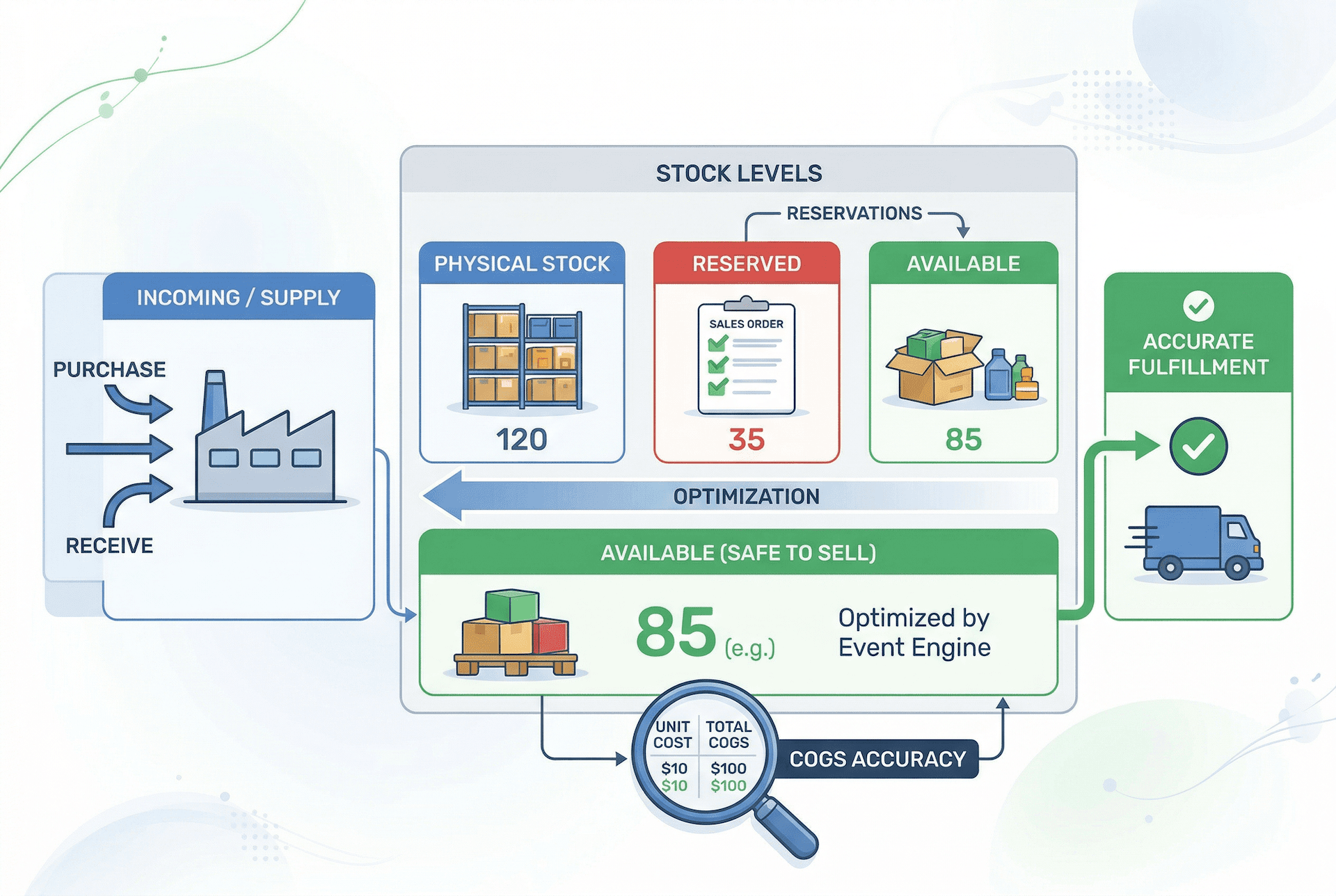
Physical stock is what is actually in the warehouse or production area. If 200 units are on the shelf, physical stock is 200.
Reserved stock is the part already committed to a confirmed need that has not yet been physically issued or shipped. That can come from a sales order, a production order, or another formal allocation that should block the same quantity from being promised again.
Available stock is what remains open for a new commitment. If physical stock is 200 and 60 units are reserved, available stock is 140.
This distinction is practical, not theoretical. Sales should usually promise available stock, not physical stock. Warehouse teams work from physical stock. Planning teams need to understand both, because a high physical quantity can still mean low availability if much of that quantity is already reserved. That is the practical meaning of available vs reserved stock, and it is also the real difference in physical stock vs available stock. It is one reason inventory management and warehouse management need more than a simple on-hand balance.
The timing of the reservation matters
Many inventory errors come from handling reservations at the wrong point in the process. If a company waits too long to reserve stock, the same units remain visible as available even after they are effectively committed to an order. That creates overpromising. If a company reserves too early without a clear business event, availability becomes artificially restricted and the team starts working around the system.
If you physically have 200 units and 60 are already committed to confirmed orders, the system should not behave as if all 200 were still free. That is where many teams start selling against inventory that is no longer truly available.
In most modern workflows, the reservation should happen when demand becomes firm enough to block inventory for another use. For sales, that is often order confirmation. For production, it is usually production release or another explicit planning milestone that means the material is now committed to that batch. A good inventory reservation system protects the quantity at that point without treating the reservation as if the stock had already left the building. The reservation does not mean the stock has left. It means the quantity is no longer free for a different demand. That distinction gives customer service and planning a more realistic picture of what can still be allocated.
Purchase order is not receipt
The same logic applies on the inbound side. A purchase order represents intent and expectation. It tells the business that material has been ordered, but it does not mean the stock is physically in the warehouse. Inventory should increase when the goods are actually received, not when the buyer creates the document.
If purchasing orders 500 units and only 320 arrive at the dock, physical stock should increase by 320, not 500. The remaining 180 are still expected, not available.
That difference matters in normal operations. Deliveries can be partial. Items can arrive damaged. Quantities can differ from the original order. A modern system should record the purchase order as expected stock and only convert the received portion into physical stock once the receipt is posted. This is one of the reasons robust purchase management is closely tied to inventory accuracy.
When companies lose track of this distinction, they usually also lose visibility over timing and exceptions, which is where a reliable inventory audit trail becomes important.
Production release is not consumption
The same principle matters inside manufacturing. When a production order is released, the system may reserve raw materials so they are no longer available for another batch or a customer order. That is a planning and allocation step. It is not yet material consumption.
If a batch reserves 40 units for production, that does not mean 40 units have already left physical stock. Mixing those two moments creates confusion for production, warehouse teams, and costing.
Physical stock should decrease when the material is actually issued to the order, scanned into work-in-progress, or otherwise recorded as consumed according to the process design. Until that moment, the material may still be physically sitting in the warehouse or staging area even though it is already committed.
Older systems often handle this poorly by collapsing release and consumption into one action. That can make the screen look simpler, but it reduces traceability. Modern systems separate those events so the business can answer two different questions clearly: what material has been committed to production, and what material has actually been consumed. That distinction is also central to stronger production management.
Why older systems create avoidable confusion
Many older inventory systems were designed around a smaller set of states. They often push several operational meanings into one number and let documents behave like physical movements.
That creates predictable problems:
- A purchase order starts to look like stock before receiving happens.
- A confirmed sales order starts to look like a shipment before anything leaves the warehouse.
- A released production order starts to look like material consumption before the issue is recorded.
- Cost can move too early because the system cannot clearly distinguish reservation, receipt, shipment, and consumption.
The result is usually not one dramatic failure. It is a long sequence of small inconsistencies: quantities that look available but are already spoken for, receipts that do not match open orders, and COGS that stops matching the real operating timeline. When that pattern becomes frequent, inventory audit trail and Why Inventory Never Matches (And How to Fix It) become useful references.
What FIFO is, what it does, and why it matters
FIFO means First In, First Out. In inventory terms, it means the oldest received units are treated as the first units to leave stock.
That rule matters because inventory is not only quantity. It is also cost. If a company buys the same item at different prices over time, the system needs a rule to decide which cost should be applied when units are shipped or consumed. FIFO uses the oldest receipt layers first.
For example, if 100 units were received at $8 and later 100 more were received at $11, shipping 60 units under FIFO means those 60 units come out of the older $8 layer first. The remaining stock keeps its later layers. That is what connects a stock movement to COGS in a way that finance and operations can both explain.
FIFO is useful because it gives the business a consistent method to value stock exits, measure margin, and understand how older and newer purchase prices are affecting profitability. In sectors with price volatility, that difference is not accounting detail. It changes product margin, batch cost, and replenishment decisions.
In older systems or simpler controls, this is often handled in less reliable ways. Some businesses work with a flat average cost and lose visibility of receipt layers. Others keep FIFO outside the main operation, in spreadsheets or month-end accounting adjustments, while the day-to-day stock system tracks only quantity. That usually creates a gap between what operations thinks happened and what finance later recognizes as cost.
FIFO cost layers depend on the same event discipline
Quantity control and cost control should follow the same operational logic. In a modern FIFO inventory system, the system does not only track how many units remain. It also tracks which receipt created those units and what each layer cost. Those receipt-based layers are the FIFO cost layers.
Suppose a company receives 100 units at $8 in January and 100 more at $11 in March. The total physical stock may show 200 units, but the cost structure is not flat. When 60 units are shipped, the system should relieve the older layer first. That is what makes FIFO meaningful in practice.
The same applies in manufacturing. When raw material is actually consumed, the system should relieve the appropriate FIFO layers at the moment of real consumption, not at the earlier planning step when the batch was merely released.
This is where stock accuracy and margin accuracy meet. If quantity is recognized at the wrong time, cost is usually recognized at the wrong time too. If the system does not preserve layers well, it may still report a quantity on hand but provide a weaker answer on what that inventory will cost when it leaves. If that is already causing recurring variance, prevent stock mismatch is a useful next read.
What modern systems do differently
Modern inventory systems are stricter about event timing and clearer about stock states.
They separate at least these questions:
- What is physically here right now?
- What part is already reserved?
- What is still available for a new order or batch?
- What quantity is expected but not yet received?
- Which FIFO layers will be relieved when stock actually leaves?
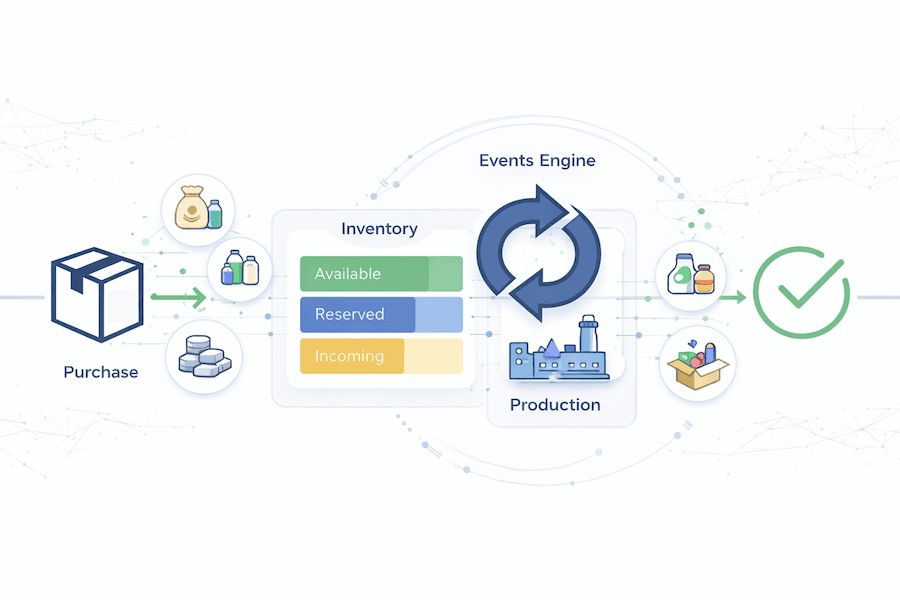
They also preserve the event history that created those answers. A confirmed order creates a reservation. A receipt creates physical stock. A shipment reduces physical stock and relieves the relevant FIFO layer. A production release reserves material. A production issue or consumption event reduces the physical balance and applies the correct cost layer.
That model gives teams a clearer operational picture and reduces the need for manual reconciliation later. It also makes cross-functional discussions simpler, because sales, warehouse, production, and finance can work from related but distinct inventory views instead of arguing over one overloaded number.
In practice, that means fewer duplicated promises, fewer blocked shipments caused by invisible reservations, fewer cost distortions created by early recognition, and less friction between operations and finance.
If you want the broader operating model behind this, What Is Event-Driven Inventory Management? explains the event logic in more detail. For a product-level view of the same approach, event-driven inventory and inventory for manufacturing are natural follow-up pages.
Final thought
Physical stock, reserved stock, and available stock should not be treated as interchangeable labels for the same balance. They describe different parts of the same operational reality. The same is true for purchase order versus receipt, and production release versus consumption. Once those distinctions are explicit, FIFO cost layers also become easier to trust because cost leaves inventory at the same point the physical movement actually occurs.
If your current system still mixes commitment with movement, or mixes planned demand with real consumption, the problem is not only inventory accuracy. It is decision quality across purchasing, warehouse execution, production, and margin analysis.
If your team still uses the same number to represent physical stock, available stock, and committed stock, the risk is not only selling wrong. It is buying, producing, and analyzing margin from an incomplete view. Start your 14-day free trial and test a flow where reservations, receipts, real movements, and FIFO follow the same operational timeline.