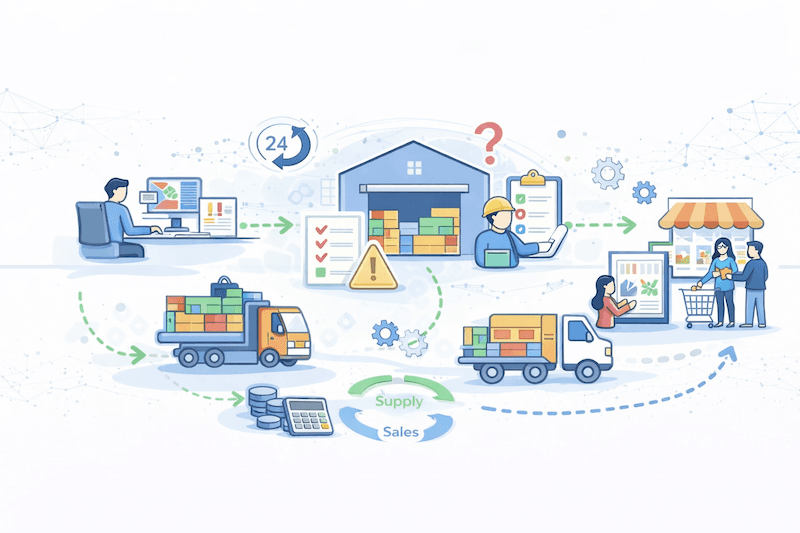
You sell in the morning, allocate orders in the afternoon, and end the day arguing about where 17 units went.
When that becomes normal, the problem is not only inventory. It is margin, delivery promises, trust between teams, and too much time spent fixing the same fire again.
The usual way: fix the number and move on
In many spreadsheets, manual controls, and traditional ERP flows, inventory works like this: a discrepancy appears, someone corrects the balance, and the day continues.
It feels efficient for a few hours. Then the cost shows up. Sales promises against a fragile number. Purchasing rushes to replace stock that may not actually be missing. Production stops because material "existed in the system" but was not truly available. At month-end, nobody can explain whether the loss came from a bad receipt, excess consumption, an incomplete transfer, or a late adjustment.
An edited balance solves the day. It does not solve the cause.
This model looks acceptable when the business is small because the team can still compensate with memory. But once volume grows, more people get involved, or inventory spreads across locations, improvisation starts turning into real operating cost.
Event-driven inventory: record what happened
Event-driven inventory follows a simple rule: the system should not keep only the result. It should keep the story that created the result.
In a weaker model, you see something like: "Current stock: 35"
In an event-driven model, you see why it became 35:
- partial receipt of 20 units from supplier A
- reservation of 8 units for a confirmed order
- transfer of 5 units from the central warehouse to the store
- consumption of 4 units in production batch B
- adjustment of 2 units due to damage found during receiving
That difference changes everything. The balance stops being an opinion or a number corrected at the end of the day. It becomes the consequence of traceable facts.
That is where inventory traceability starts becoming useful in daily operations, not only in theory.
The internal conversation changes too. Instead of "I think someone changed inventory," the question becomes "at which event did expected and actual start to diverge?"
If you are starting now
Many founders assume this only matters later. In practice, it matters even more at the beginning.
The early stage is when habits are still cheap to create and expensive to undo later. If the operation starts on top of manual fixes, parallel spreadsheets, and team memory, growth will not fix that. It will only spread the problem.
Example: a small food brand
Imagine a small operation buying inputs every week, producing in short batches, and selling through two channels. In month one, the spreadsheet feels enough. By month three, conflicts start appearing:
- purchasing believes there is still raw material for the week
- production says the next batch cannot run
- sales promises replenishment by tomorrow
- nobody knows which receipt was already consumed, reserved, or lost
That is when many companies realize too late that "simple control" was not control. It was informal memory dressed up as process.
Starting with event-driven logic prevents that. You keep the operation lean without losing the trail of what actually happened.
If the business is already running under pressure
When a company is already selling, buying, transferring, and producing at speed, the pain becomes more explicit.
At that stage, the problem is not only "inventory is wrong." The problem is more concrete:
- recurring stockouts on the same items
- more expensive emergency purchasing
- production stops because material the system said existed is not really there
- slow, exhausting month-end reconciliation
- friction between sales, operations, purchasing, and finance
Without reliable history, every team starts defending its own version of reality.
Use case: two stores, one SKU, two truths
One store asks for an urgent transfer because it says the item is out. The distribution center checks the balance and says there is still stock. When the team investigates, it finds that part of that quantity was already reserved for orders, another part was still under verification, and a previous transfer had never been completed correctly.
Without a traceable event flow, this looks like "a replenishment problem." With traceable events, you can see the real sequence and act on it. That is exactly where tracking warehouse movements explicitly stops being a detail and becomes control.
Use case: production and purchasing pointing in opposite directions
Production says raw material is disappearing faster than it should. Purchasing answers that orders were placed and receipts for the week are recorded.
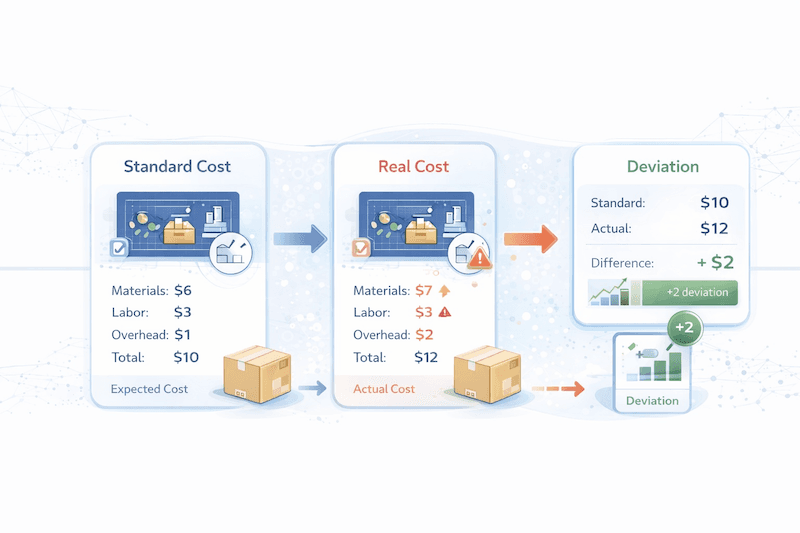
Without event history, the discussion becomes opinion. With event history, you compare planned versus actual consumption by batch, see when material arrived, when it was reserved, and when it was actually consumed. That is the kind of clarity that makes production management produce practical results.
Sometimes the variance starts in weighing. Sometimes in unclassified loss. Sometimes in an adjustment posted too late. The point is simple: with reliable history, you stop correcting in the dark.
What changes in practice
When inventory starts being controlled through events, the gain appears in daily work before it appears in strategy decks.
- Fewer bad promises: sales sees what is truly available, not only what is still physically in the building.
- Fewer emergency purchases: purchasing stops reacting to phantom shortages created by poorly explained balances.
- Less cross-team arguing: each discrepancy points to a specific receipt, transfer, consumption, or adjustment.
- Less month-end blindness: finance gets a clearer view of losses, variances, and margin swings.
- More useful investigation: with an inventory audit trail, the team finds the step that opened the gap instead of only correcting the final number.
How Loribase helps when the pain is already real
If your team currently depends on parallel spreadsheets, manual fixes, and memory to make inventory "match," Loribase enters exactly at that pain point.
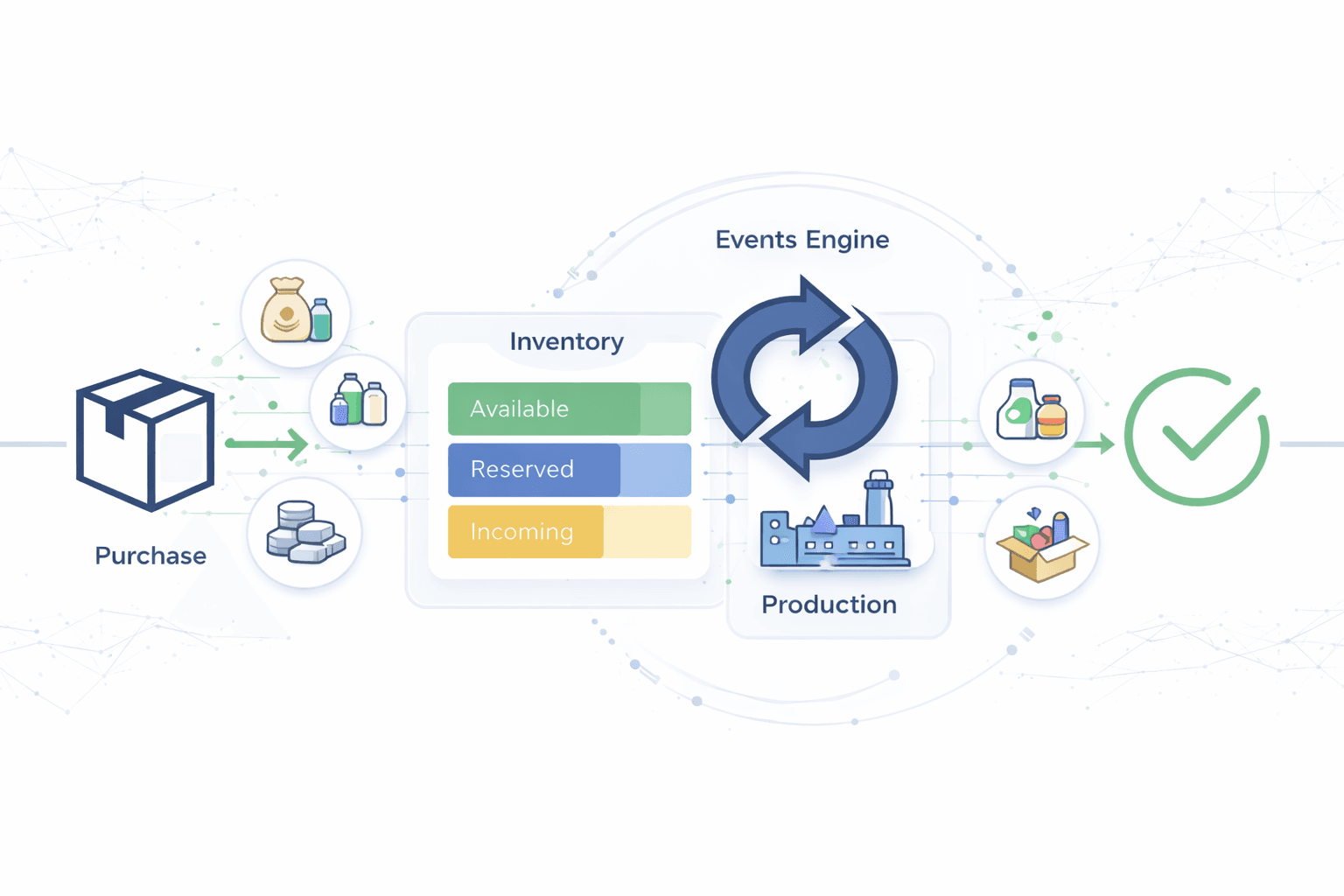
Instead of hiding operations behind an editable balance, it helps record the real sequence of what happened across purchase management, inventory, production, and movements.
In practice, that means:
- recording receipts, reservations, transfers, consumption, and adjustments as separate events
- keeping operational context about who did it, when it happened, where it happened, and why
- separating intent from execution so a document does not look like a physical movement
- comparing planned versus actual without rebuilding the story manually
- connecting inventory, purchasing, and production inside one operational history
If you want the broader view, the inventory management page shows how this logic connects to the rest of the operation.
What can start becoming visible in the first 30 days
Once a team starts operating this way, a few effects usually show up quickly:
- partial receipts stop turning into "full receipt corrected later"
- adjustments start carrying reason, context, and accountability
- transfers stop disappearing halfway through the process
- inventory meetings get shorter because the focus moves from "how much is there?" to "where did the gap open?"
- the team starts separating physical, reserved, and truly available stock more clearly
This is not magic. It is enough operational visibility to act before divergence becomes routine.
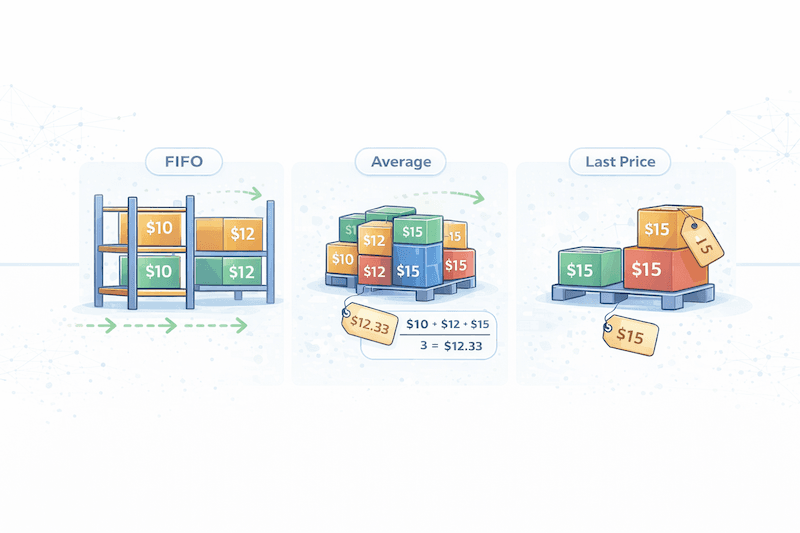
If stock states are already part of the problem in your operation, How Modern Inventory Systems Handle Reservations, FIFO, and Real Stock is the next useful angle.
If your team still needs an extra count to understand what happened yesterday, the next step is not counting more. It is testing a flow where every receipt, reservation, transfer, and adjustment leaves a trail. Start your 14-day free trial and see this logic working inside your own operation.
Final thought
An edited balance hides the path. Traceable history shows where control was lost.
If you want to move from constant correction to real control, the natural next step is Why Inventory Never Matches (And How to Fix It).