Some months your margins look great. In others, they drop without a clear reason. Sales volume is similar, suppliers haven’t changed much, and prices seem stable, but the result fluctuates anyway. Over time, this inconsistency makes planning harder, decisions slower, and confidence lower.
Most businesses assume this is a pricing problem or a supplier issue. In reality, the root cause is often simpler. They are operating without a stable reference for cost. Everything is based on what happened, not on what should happen.
The most common pattern looks like this: the company records what it paid the supplier, sends freight to overhead, adds a markup percentage, and hopes the margin holds. When it doesn't, they adjust the price and repeat the cycle. There is no reference point. Just reactions.
What standard cost actually is
Standard cost is a predefined cost used as a reference for planning, pricing, and performance analysis. It does not try to reflect the exact cost of every transaction. Instead, it represents what a product should cost under normal operating conditions.
This distinction is important. Real cost is reactive, it tells you what already happened. Standard cost is proactive, it gives you a baseline to make decisions before execution. Without that baseline, every decision depends on fluctuating inputs, and the operation becomes harder to control.
In practice, standard cost is usually defined per product or variant and includes expected material cost, labor, and operational overhead. It becomes the anchor for pricing, margin expectations, and production planning.
Standard cost vs accounting cost
Standard cost is often confused with accounting cost, but they serve different purposes. Accounting cost records what was actually incurred after transactions happen and after costs are allocated in the books. It belongs to financial history.
Standard cost is different. It is a managerial reference used to evaluate operations before and after execution. Accounting cost tells you what happened in financial terms. Standard cost helps you judge whether the operation behaved as expected.
Common types of standard cost
There is more than one way to define a standard cost.
- Ideal standard cost assumes perfect conditions, with no waste, delays, or inefficiencies
- Current standard cost assumes normal operating conditions, including expected losses and average efficiency
- Estimated standard cost is a practical forecast updated from current purchasing and production patterns
The specific model matters less than consistency. The important thing is to define which reference your company will use and apply it systematically.
Why real cost alone is not enough
Real cost is essential for understanding your operation, but it is not enough to manage it. Because it changes over time, it cannot be used as a stable reference for decisions that need consistency.
Imagine pricing a product based only on the latest purchase cost. If that cost fluctuates, your margins will fluctuate as well. You may react by adjusting prices constantly, which creates instability in your market positioning, or you may keep prices fixed and absorb the variation, which erodes your margin without clear visibility.
Without a standard reference, you are always reacting. With a standard cost, you can separate expected performance from actual performance and understand where deviations come from.
A practical example
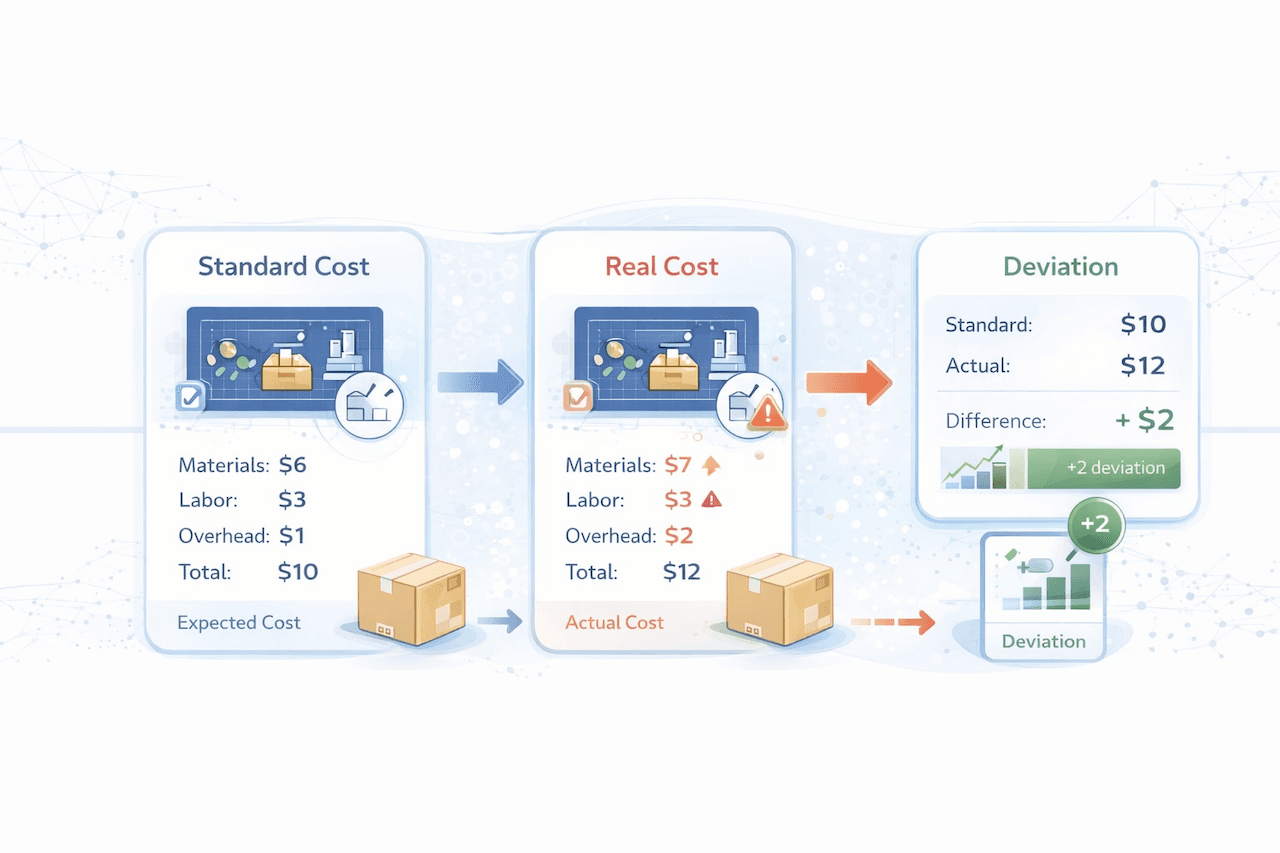
Consider a product that typically costs $10 to produce. You define that as your standard cost and build your pricing strategy on top of it.
In one month, due to supplier variation and logistics costs, the real cost increases to $12. If you only look at real cost, your margin appears lower, but you don’t know whether the issue is pricing, purchasing, or operational inefficiency.
With standard cost, the comparison becomes clear. The product should cost $10, but it actually cost $12. That $2 difference is a deviation that needs explanation. Instead of guessing, you now have a concrete signal to investigate.
How to define standard cost in practice
A practical implementation usually follows four steps:
- Define the expected material cost from your bill of materials or production formula
- Define expected labor and operational overhead
- Choose whether your baseline is ideal, current, or estimated
- Review deviations regularly so the reference stays useful instead of becoming stale
Standard cost works best when it is maintained as an operational reference, not when it is defined once and then ignored.
Where standard cost creates real value
The main value of standard cost is not in the number itself, but in the comparison it enables. By keeping a stable reference, you can measure how your operation performs against expectations.
This unlocks several capabilities:
- Consistent pricing based on expected margins
- Clear visibility of deviations in production and purchasing
- Better planning of future operations
- Faster decision-making because you are not recalculating everything on each variation
Without this reference, your business operates in a constant feedback loop. With it, you introduce structure and predictability.
Standard cost in production environments
Standard cost becomes even more important in production. When you manufacture products, cost is not just what you pay to a supplier, but the result of a process involving materials, labor, and time.
In this context, standard cost acts as the expected cost of executing a bill of materials or production formula. It allows you to estimate margins before production starts and evaluate performance after it ends.
If the actual production cost deviates from the standard, you can analyze the reason. Was there waste? Did material prices increase? Did production take longer than expected? Without a standard reference, these questions become much harder to answer.
How it differs from inventory costing methods
Standard cost is often confused with inventory costing methods, but they serve completely different purposes.
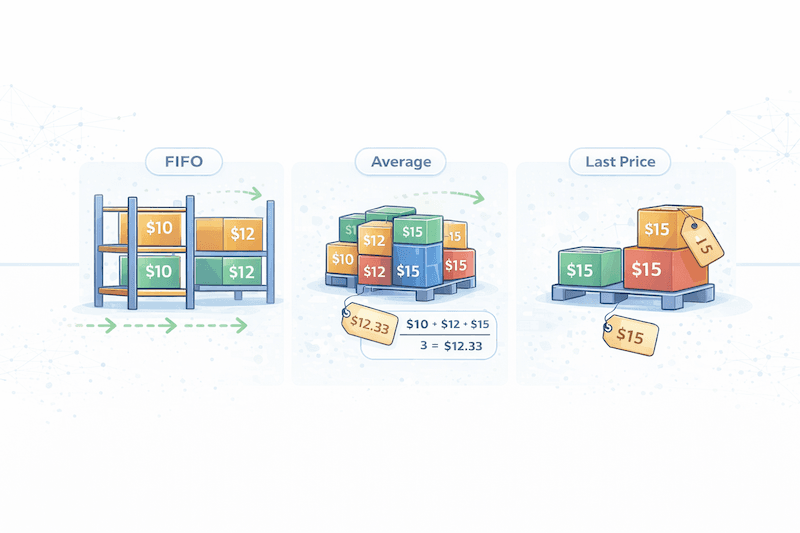
Inventory costing methods such as FIFO, weighted average, and last purchase price define how cost flows through inventory over time. They are operational and affect how stock is valued and consumed.
Standard cost does not change how inventory is valued. It exists as a parallel layer used for planning and analysis. It does not replace real cost, and it does not overwrite it. Instead, it gives you a reference to compare against.
If you want to understand how costing methods work in practice, see: Inventory Costing Methods: FIFO, Weighted Average and Last Purchase Price
How it connects with landed cost
To understand standard cost properly, it helps to place it in the broader structure of cost.
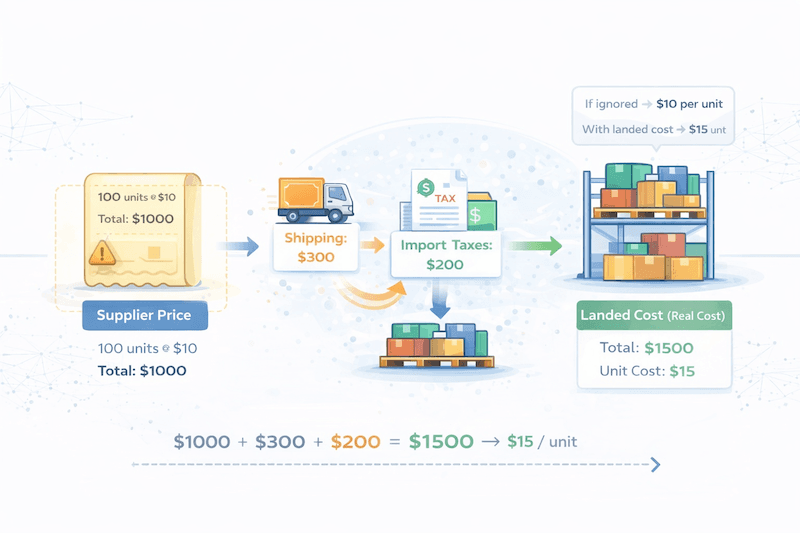
Landed cost defines the real cost of getting a product into inventory. Costing methods define how that cost is consumed over time. Standard cost defines what that cost is expected to be.
These are not competing concepts. They operate at different moments and solve different problems.
- Landed cost answers: what did this actually cost?
- Costing method answers: which cost is being used now?
- Standard cost answers: what should this cost be?
When these layers are clearly separated, the system becomes both accurate and useful. Real cost reflects reality, and standard cost provides a stable reference to evaluate that reality.
If you haven’t explored landed cost yet, see: What Is Landed Cost and Why It Changes Your Real Profit
The real impact on margins
Businesses without standard cost often believe their margins are unpredictable. In reality, what they lack is a consistent way to measure them.
When you introduce standard cost, margins stop being a moving target. You know what margin you expect, and any variation becomes visible immediately. This changes how decisions are made. Instead of reacting to outcomes, you start managing deviations.
Over time, this leads to more stable pricing, better supplier negotiation, and more efficient production processes.
How modern systems implement standard cost
In modern systems, standard cost is not a replacement for real cost. It is a configurable layer that exists alongside it.
You define standard cost per product or variant, and the system uses it for planning, pricing suggestions, and performance analysis. Real operations continue to use actual cost, ensuring that inventory and financial data remain accurate.
The key is that both numbers coexist without interfering with each other. One represents expectation, the other represents reality.
How Loribase approaches standard cost
In Loribase, standard cost is treated as a management layer, not as a shortcut to override real data. Inventory continues to be valued based on real events, with full traceability through lots and movements. At the same time, standard cost provides a stable reference for planning, pricing, and analyzing performance.
This separation allows you to operate with accurate data while still having the tools to understand and improve your margins. You don’t have to choose between simplicity and correctness. You can have both, because each layer serves a clear purpose.
If you want to see how this fits into a broader event-driven model, start here: What Is Event-Driven Inventory Management? (And Why It Matters)
Final thought
If your margins change every month, the problem is not randomness. It is the absence of a stable reference.
Standard cost does not eliminate variation. It makes it visible, measurable, and manageable.