Most businesses think they understand their margins. They know how much they paid for a product, how much they sold it for, and the difference between those two numbers. On paper, everything seems clear. But after a few months of growth, something starts to feel off. Margins fluctuate without explanation, profits don’t match expectations, and decisions become reactive instead of deliberate.
This usually happens because “cost” is being treated as a single number, when in reality it is the result of multiple decisions happening at different moments in time. Inventory costing is not one calculation. It is a system of layers that define how cost enters your operation, how it flows through it, and how it is interpreted for decision-making.
Once you see these layers clearly, most of the confusion around margins disappears. Without that clarity, even the most sophisticated reports will still lead you to the wrong conclusions.
The three layers of inventory cost
Every inventory system, whether explicit or not, operates on three conceptual layers: how cost enters the system, how cost is consumed, and how cost is evaluated. Most problems happen when these layers are mixed or when one of them is missing.
The "three layers" framework is best understood as a practical explanatory model, not as a universal accounting taxonomy. Its value is not in claiming that every company names costing this way, but in making three different decisions visible: how cost enters inventory, how it is selected at consumption, and how it is evaluated for management.
The first layer is cost entry, which defines the real cost of acquiring inventory. The second is cost flow, which determines which cost is used when inventory leaves the system. The third is cost reference, which defines what cost should be under expected conditions. These layers are independent, but they interact constantly.
Understanding inventory costing means understanding how these three layers work together, not choosing a single method in isolation.
Layer 1: How cost enters inventory (Landed Cost)
The cost of a product is rarely just the purchase price. In real operations, you also pay for freight, taxes, insurance, handling fees, and sometimes currency variation. When these elements are ignored or treated separately, your inventory is systematically undervalued, and your margins become artificially inflated.
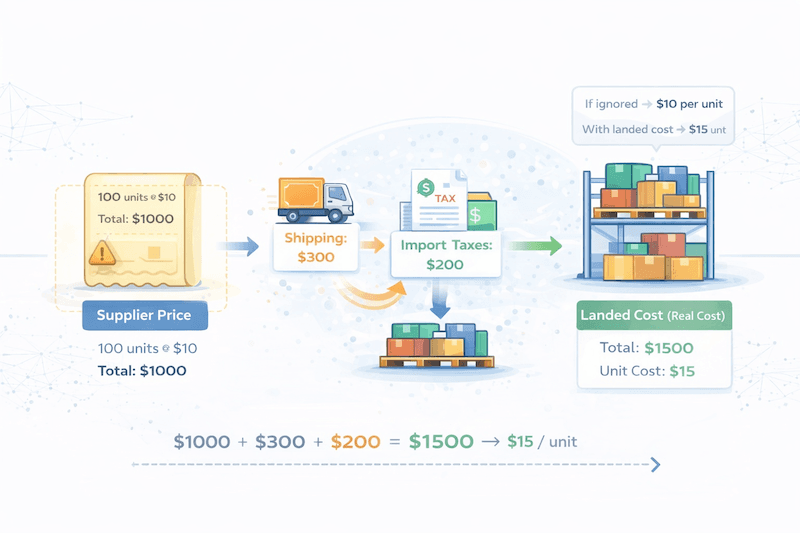
Landed cost exists to solve this problem. It aggregates all acquisition-related expenses and distributes them across the units received, creating a true cost of entry for each item or lot. In practice, it is part of the real cost of entry, not just an after-the-fact reconciliation line. In some accounting environments it may also appear through allocation or adjustment mechanics, but operationally the point is the same: if acquisition-related costs are not incorporated into unit cost, inventory is understated from the start.
A simple example makes the logic clearer: if you buy 100 units at $8 each, your purchase price is $800. Add $120 in freight, $30 in import-related fees, and $10 in insurance, and the total landed cost becomes $960. That means the real entry cost is $9.60 per unit, not $8.00.
To go deeper into how this works in practice: What Is Landed Cost and Why It Changes Your Real Profit
Layer 2: How cost flows through inventory (Costing Methods)
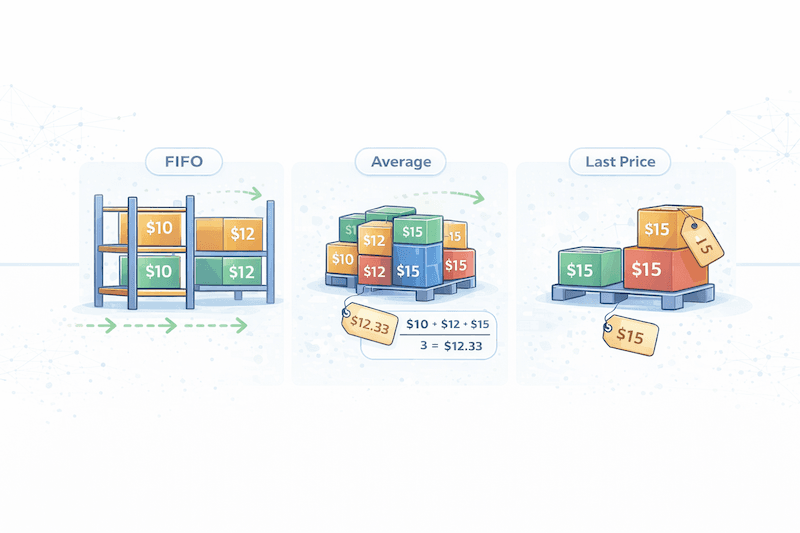
Once cost is inside the system, the next question is: which cost should be used when inventory is consumed? This is where costing methods come in. FIFO, weighted average, and last purchase price all operate on the same data, but they produce different results because they answer this question differently.
FIFO preserves the historical sequence of purchases and applies cost based on the actual order in which inventory was acquired. Weighted average smooths all costs into a single value, reducing volatility but also removing per-lot granularity. Strictly speaking, last purchase price is better understood as an operational simplification than as a classical inventory valuation method on the same footing as FIFO or weighted average. Businesses still use it because it is fast, intuitive, and often good enough for day-to-day decisions when price volatility is limited.
You may also hear about LIFO in accounting discussions. It is prohibited under IFRS and still permitted under U.S. GAAP in some contexts, which is one reason inventory costing conversations often mix operational logic with reporting rules. For most operating teams, however, the more practical comparison is between FIFO, weighted average, and simpler proxy methods such as last purchase price.
None of these methods change the cost itself. They change how that cost is selected at the moment of use. This distinction is critical, because it means that choosing a method does not fix incorrect input, it only changes how that input is interpreted.
For a detailed comparison: Inventory Costing Methods: FIFO, Weighted Average and Last Purchase Price
Layer 3: How cost is evaluated (Standard Cost)
Even with accurate entry and a clear flow, you are still looking at the past. Costing methods tell you what happened, but they do not tell you what should have happened. Without that reference, it is difficult to measure efficiency, identify deviations, or plan future operations.
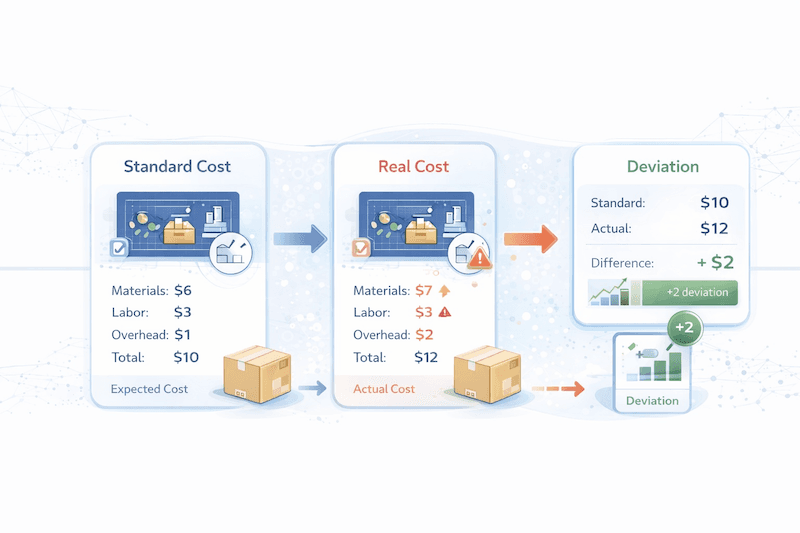
Standard cost introduces that missing layer. It defines an expected cost based on known inputs, such as materials, labor, and overhead. This expected value becomes a benchmark against which real costs can be compared. The difference between the two reveals operational inefficiencies, supplier variation, and process issues that would otherwise remain hidden.
This is what allows costing to move from reporting into management. Instead of reacting to results, you start controlling them.
For example, if the standard cost of a unit is $12.00 but the actual cost comes in at $13.40, the unfavorable variance is $1.40 per unit. Over a batch of 500 units, that becomes a $700 gap, which is exactly the kind of signal managers need to investigate supplier changes, process loss, or overhead drift.
To understand this layer in depth: Standard Cost: The Secret Behind Predictable Margins
How to choose without confusing the layers
Choose FIFO when cost traceability matters and purchase timing materially changes margins. Choose weighted average when you want smoother cost behavior and do not need lot-level precision in every analysis. Use last purchase price when the goal is operational speed and rough decision support, not strict historical matching. Use standard cost as a management reference to plan, price, and measure variance, not as a replacement for actual inventory value.
The key is to avoid asking one layer to do another layer's job. Landed cost improves the quality of cost entry. FIFO and weighted average define cost flow. Standard cost gives management a benchmark.
Why most systems get this wrong
Many systems blur the boundaries between these layers. The most common failure is a "standard cost mode" that replaces actual inventory value with a fixed price. On the surface it looks like a configuration option. In practice, it collapses Layer 3 into Layer 2 and silently distorts every margin report, every stock valuation, and every financial summary the business relies on.
A subtler version of the same problem happens when landed cost is treated as a line item on a purchase order rather than a cost component distributed across units. The invoice gets reconciled, the numbers balance, but the per-unit cost inside the inventory system is still wrong. Costing methods then operate on that wrong number, compounding the error at every consumption event.
The core issue is not the absence of features, but the absence of separation. When entry, flow, and reference are collapsed into a single "cost field", fixing one aspect of the calculation inadvertently corrupts another. The model does not degrade gracefully. It breaks at the seams.
A practical way to think about it
You can think of inventory cost as a pipeline. At the beginning of the pipeline, cost is defined through landed cost. In the middle, it flows through the system according to the chosen method. At the end, it is compared against a standard to evaluate performance.
Each stage answers a different question:
- How much did this actually cost? -> Landed cost
- Which cost should be used now? -> Costing method
- Was this cost expected? -> Standard cost
When all three answers are available and consistent, your numbers start to make sense again.
How Loribase structures costing
Loribase is designed around this separation of layers. Cost entry, cost flow, and cost reference are treated as independent concerns, each applied at the right moment in the lifecycle of inventory.
Landed cost is recorded as part of the receiving process, ensuring that every unit enters the system with a complete and accurate cost. Costing methods are configured at the organization level and applied consistently across inventory, sales, and production, without rewriting history when changes occur. Standard cost can operate as a parallel reference layer for planning, pricing, and performance analysis without distorting real inventory valuation.
All of this operates on top of an event-driven inventory model, where every cost originates from a real movement. This guarantees that costing is always grounded in actual operations, not manual adjustments or abstract assumptions.
If you want to understand that foundation: What Is Event-Driven Inventory Management? (And Why It Matters)
Final thought
Inventory costing is not about choosing a formula. It is about building a system that reflects reality at every stage, from acquisition to consumption to analysis. When these layers are clear, your margins stop being a guess and start becoming a controllable outcome. That is the difference between a business that reacts to numbers and one that manages them.