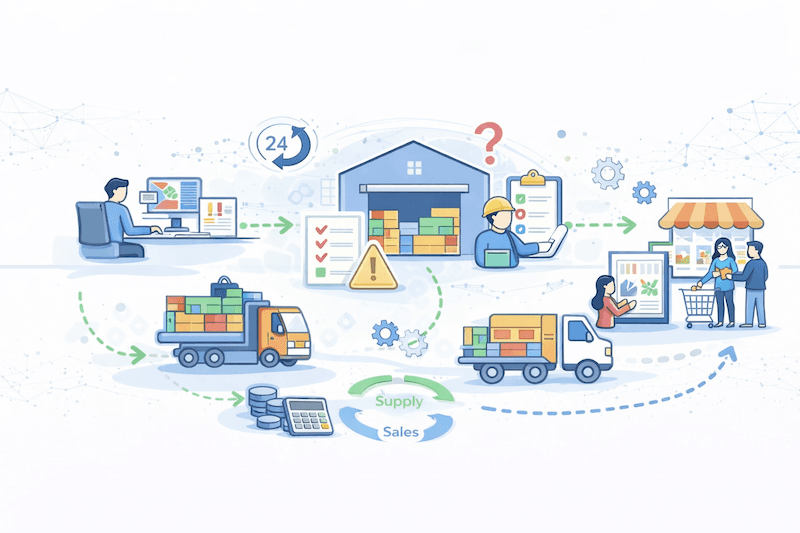
You buy a product for $10 and sell it for $20, and on paper everything looks correct: a $10 gross profit per unit. But when you close the month, the cash in your account doesn’t reflect that result. The operation feels tighter than expected, and the numbers start drifting away from reality. That gap usually isn’t caused by pricing mistakes or weak sales. It comes from something more structural: the cost you’re using is incomplete.
The classic small-business mistake is simple: record only the supplier price as product cost, send freight and taxes to finance, price as if those charges had nothing to do with inventory, and discover the distortion only at month-end.
Most small businesses treat cost as the price paid to the supplier. It’s simple, easy to track, and often good enough in the early stages. But in practice, getting a product into your warehouse involves much more than that single number. Freight, import taxes, insurance, customs or receiving fees, and other directly attributable acquisition costs all accumulate around that purchase, turning what looks like a straightforward cost into something materially different. Ignoring these elements doesn’t just create small inaccuracies. It changes how your business behaves.
What landed cost actually represents
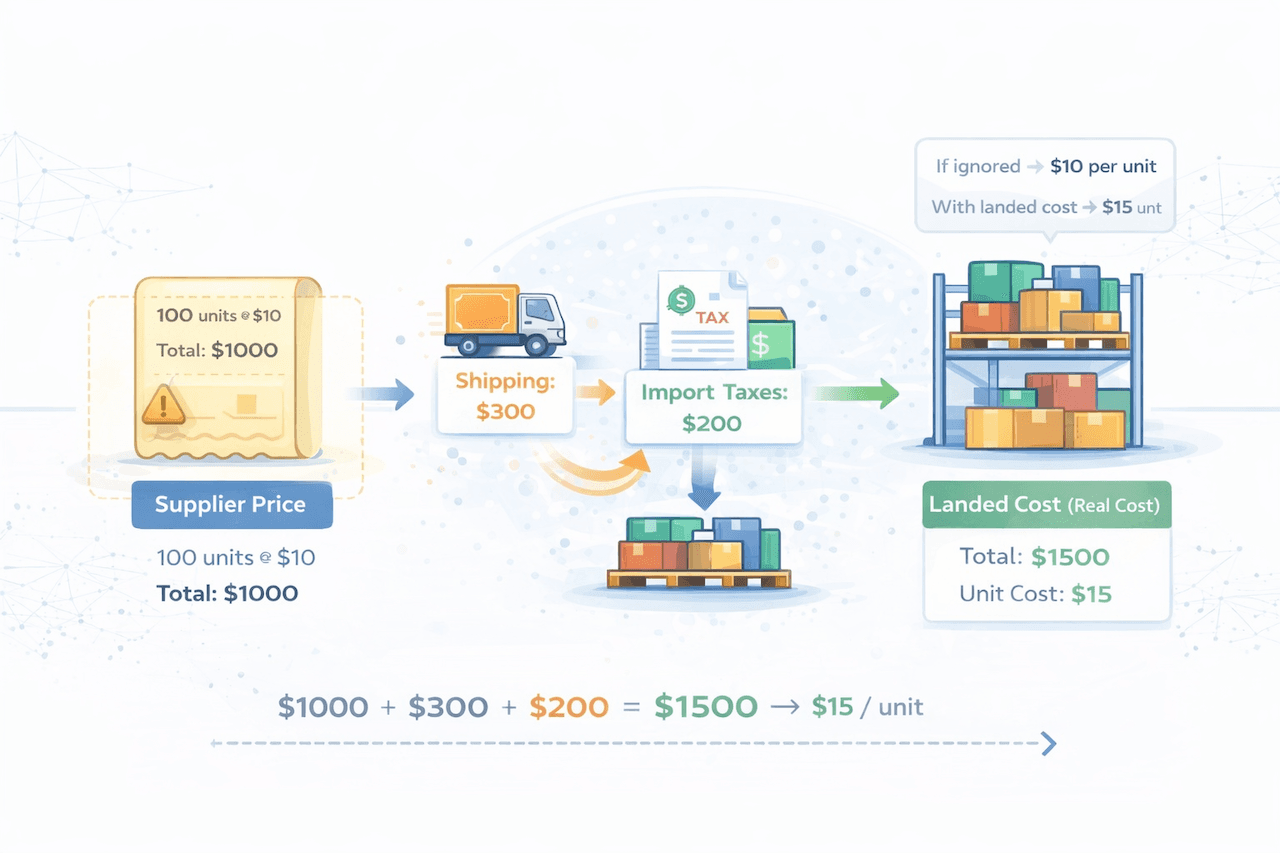
Landed cost is the total cost required to acquire a product and make it available for sale. It is not an accounting abstraction, it is an operational reality. If you pay $1,000 for products but spend another $500 to get them into your warehouse, your real cost is not $1,000, it is $1,500. Any system that treats those numbers separately is already creating a distortion.
This is where many operations start drifting without noticing. The purchase price is visible and easy to register, while additional costs are fragmented across invoices, logistics providers, and financial records. As a result, the inventory ends up being valued below its real cost, and every decision that depends on that value becomes less reliable over time.
A practical example
Imagine importing 100 units of a product. You pay $1,000 to the supplier, $300 in shipping, and $200 in import taxes. The total cost of that operation is $1,500, which means each unit effectively costs $15. However, if your system only records the purchase price, it will assume each unit costs $10. That difference doesn’t stay isolated. It propagates into every sale, every margin calculation, and every decision you make.
And this is not only an importer problem. The same distortion appears in domestic operations when freight, receiving charges, insurance, or other acquisition costs stay outside inventory and get treated as unrelated expenses.
At first, this looks like a simple underestimation. In reality, it creates a consistent bias in your operation. You believe your margins are higher than they actually are, you price products more aggressively than you should, and you may even prioritize the wrong suppliers because the true cost structure is hidden.
Landed cost formula
A practical way to think about it is:
Landed cost = supplier price + inbound freight + duties and taxes + insurance + customs, brokerage, and receiving fees + other direct acquisition costs
And at unit level:
Per-unit landed cost = total landed cost / received quantity
The exact composition varies by operation, but the rule is stable: if a cost is directly attributable to bringing that item into available stock, it usually belongs in landed cost.
What should be included in landed cost
- Supplier price or purchase price
- Inbound freight from supplier to warehouse
- Import duties, non-recoverable taxes, and customs charges
- Cargo insurance tied to that shipment
- Brokerage, clearance, port, and receiving-related fees
- Inland transportation needed to place the goods into your warehouse
The point is not to create an endless list of fees. The point is to capture the real acquisition cost of the inventory layer being received.
What usually should not be included in landed cost
Some costs affect profitability, but they do not belong to product entry cost. Usually those include:
- Sales commissions and marketing expenses
- Outbound freight to the customer
- General warehouse overhead after the item is already available for sale
- Administrative expenses unrelated to receiving
- Financing costs, interest, or late-payment penalties
Keeping this boundary clear matters. If everything becomes inventory cost, the number stops helping you understand acquisition efficiency.
Why this error is so common
The root of the problem is not a lack of data, but how systems model cost. Many tools treat freight, taxes, insurance, brokerage, and receiving-related charges as financial entries instead of inventory inputs. From an accounting perspective, this separation can make sense. From an operational perspective, it breaks the connection between what you paid and what you actually have in stock.
This is why companies often say that their numbers are correct, but the business doesn’t feel right. The data is technically accurate within each module, but the system fails to connect cost to the physical reality of inventory. The result is a model that looks consistent in reports but doesn’t reflect how the operation actually behaves.
When landed cost happens and why it matters
One of the most important distinctions is understanding when landed cost is applied. It does not happen when you sell a product, and it does not happen when you calculate margin. It happens at the moment the product enters your warehouse.
This is the point where cost becomes real for the operation. Once the item is in stock, every future movement depends on that initial valuation. If the cost is wrong at entry, every downstream calculation inherits that error. No costing method can fix this later, because the problem is not in the calculation logic, it is in the input itself.
Another operational complication is timing. Some inbound charges arrive days or weeks after the goods are physically received. If the system cannot reallocate those later charges back to the correct incoming layer, part of the inventory may already have been sold with an incomplete unit cost.
Why landed cost changes even when supplier price does not
Many teams assume that if the supplier price stayed flat, the real cost also stayed flat. That is rarely true. Landed cost moves because freight markets move, fuel surcharges change, exchange rates fluctuate, customs rules shift, and port or route delays create new charges.
This is why two purchases with the same supplier price can generate different real margins. The unit price may be stable while the cost to place that unit into stock is not.
Common landed cost mistakes
- Treating only the supplier invoice as product cost
- Posting inbound freight and customs charges only in finance
- Mixing inbound acquisition costs with outbound delivery costs
- Allocating indirect costs with no rule or basis
- Posting additional costs too late, after inventory was already sold
How it relates to inventory costing methods
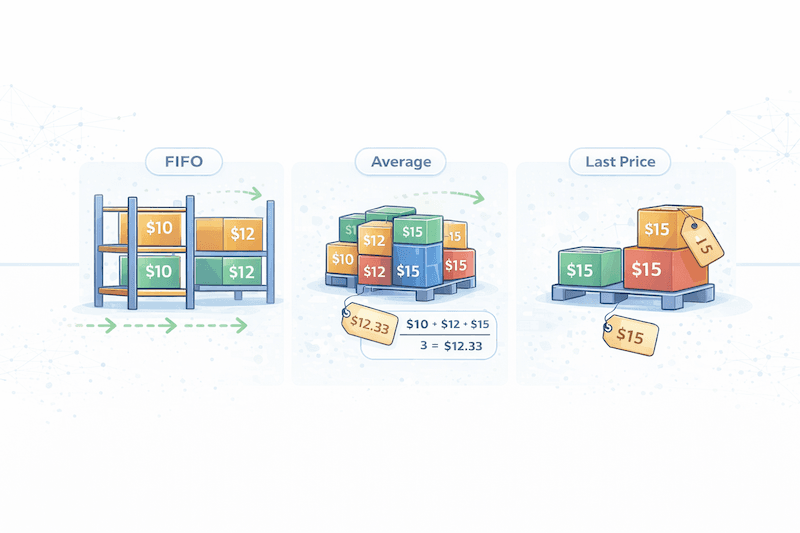
Landed cost is often confused with costing methods, but they operate at different moments. Costing methods such as FIFO, weighted average, or last purchase price define how cost is consumed over time. Landed cost defines what that cost actually is when it enters the system.
This distinction is critical. A well-configured FIFO system with incorrect input cost will still produce incorrect results, just in a structured way. The method determines how cost flows, but it cannot correct a cost that was incomplete from the beginning.
To understand how these methods compare and behave in practice, see Inventory Costing Methods: FIFO, Weighted Average, and Last Purchase Price.
The real impact on your operation
Ignoring landed cost rarely causes immediate failure. Instead, it creates a slow and consistent distortion that affects decisions over time. Margins appear higher than they are, pricing becomes disconnected from reality, and operational efficiency becomes harder to evaluate. The business may grow, but it grows on top of flawed assumptions.
This is why landed cost is not just a financial detail. It is a strategic component of inventory management. It determines whether your operation is being measured against reality or against a simplified model that no longer holds as the business scales.
How modern systems handle landed cost
In a well-designed system, landed cost is not an adjustment made after the fact. It is part of the inventory flow itself. When goods are received, the system records the purchase and allocates additional costs directly to the items or lots being received. This ensures that the unit cost is correct before it becomes part of inventory.
From that moment forward, every operation uses that corrected value. Sales reflect real margins, production consumes real cost, and analysis is grounded in the same numbers that drive the physical movement of goods.
Loribase is designed around that cost architecture. In this model, landed cost belongs to receiving: freight, taxes, and other acquisition costs are attached to the incoming inventory layer instead of being treated as disconnected afterthoughts. The goal is simple: every downstream calculation should start from a number that reflects what the product actually cost to acquire.
Where landed cost fits in the bigger picture
Landed cost, inventory costing methods, and standard cost are often discussed together, but they operate at different moments and serve different purposes.
- Landed cost happens at receiving. It defines what a unit actually costs to acquire and bring into stock, including all indirect acquisition costs. This is the input.
- Costing methods (FIFO, weighted average, last purchase price) define how that input flows out over time. FIFO uses the oldest acquisition cost first; weighted average distributes the running total across all units in stock. This determines how cost moves as goods are consumed.
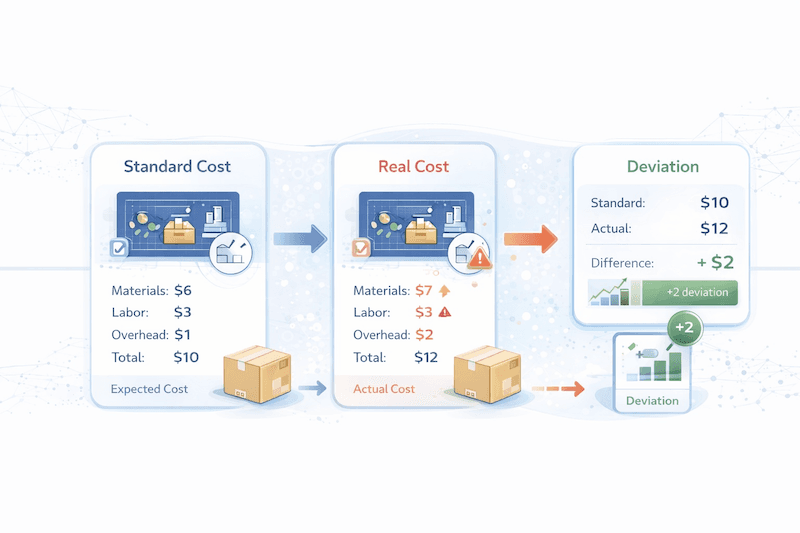
- Standard cost is a separate management layer. It defines a planned reference cost used for budgeting, production analysis, and variance tracking. It does not revalue inventory and does not change with purchases.
These are not alternatives to choose between. A business applies all three simultaneously. Landed cost determines what enters. The costing method determines how it flows. Standard cost provides the reference for planning.
Confusion happens when they are treated as substitutes for each other. Clarity comes when each one is applied at the right moment, in the right layer.
FAQ
Is landed cost the same as cost of goods sold?
No. Landed cost defines the acquisition cost when the item enters stock. Cost of goods sold depends on how that cost later flows out through the costing method used by the business.
Does landed cost apply only to imports?
No. Imports make the problem more visible, but domestic purchases can also require freight, insurance, receiving, or handling costs that should be attached to inventory entry.
What if the extra charge arrives after receiving?
The system should still attach that charge back to the correct receipt or inventory layer. If it stays disconnected in finance, the margin distortion remains.
Final thought
If your cost is wrong when a product enters your warehouse, every decision built on top of it will also be wrong, even if your reports look consistent.
What Is Event-Driven Inventory Management? explains the operational model that makes accurate cost tracking possible from the moment goods arrive.
Once the cost of entry is right, the next question is how it flows through the system. Inventory Costing Methods: FIFO, Weighted Average, and Last Purchase Price covers that in detail.
If the margin gap described at the top of this article sounds familiar, start your 14-day free trial and see what your real cost structure actually looks like.