Your system says you have 42 units. The shelf says you have 17. And no one knows which number is correct.
Inventory errors are not random. They follow patterns that repeat across companies of different sizes and industries. Late updates, manual corrections, disconnected tools, and unclear rules about how inventory should move are some of the most common ones. Each issue feels small in isolation, but together they create stockouts, overpurchasing, incorrect costing, and constant operational friction.
Why inventory errors keep happening
Most inventory problems are not caused by careless teams. They are caused by systems and habits that look manageable at small scale but break down when volume grows. A single shared spreadsheet may feel enough for a small business. For five people updating it on different devices throughout the day, it starts failing silently.
The problem is not effort. The problem is structure. When the process does not enforce consistency, errors stop being exceptions and become part of the system.
The most common inventory errors (and how to prevent them)
1. Manual data entry without validation
Manual entry is the single biggest source of inventory error. Quantity transpositions, unit conversion mistakes, wrong SKU codes, duplicate entries, and postings to the wrong location are all natural consequences of a process that depends on humans typing numbers without automated checks.
The solution is not to stop trusting people. The solution is to reduce the number of moments where manual entry can quietly introduce a mistake. Barcode scanning at receiving, structured forms with required fields, and automated alerts for quantities that fall outside expected ranges all help. Systems built around event-driven inventory go one step further by making every change traceable to a real operation, instead of an unexplained manual correction.
2. Updates entered after the fact
Stock moves when goods are received, consumed, transferred, or shipped. If the system is updated later, at the end of the shift, at the end of the day, or whenever someone "has time", every decision made in between is based on stale information.
Sales promises against numbers that no longer reflect what is available. Purchasing reacts to shortages that have already been resolved. Production stops because material "should" be there. Delayed updates are one of the most common and least visible sources of stock discrepancy.
The closer the system is to real-time, the more useful it becomes for the people actually using it.
3. No distinction between available and reserved stock
Many businesses track one number per item. In practice, no item is simply "in stock." Some units are physically on the shelf, some are already reserved for confirmed orders, some are in transit between locations, and some are blocked following a quality check.
When those distinctions are missing, teams make conflicting decisions from the same number. Sales promises inventory that the warehouse has already separated for another order. Production plans using material that is already committed elsewhere.
Treating available stock and reserved stock as the same thing is not a minor gap. It is one of the most reliable ways to generate customer complaints and intra-team conflict. Inventory management becomes more reliable when those states are explicit.
4. Purchase orders treated as received stock
When a purchase order is created for 100 units, those 100 units are expected, not received. They should not enter available stock until they actually arrive and are physically counted at receiving.
Treating the order itself as stock leads to decisions made against quantities that may never materialize in that exact form. Partial deliveries happen. Items can arrive damaged. Quantities differ. Until goods are formally received and recorded, they are still an expectation. Purchase management that separates purchase intent from physical receipt prevents these errors before they compound.
5. No lot or batch tracking
For businesses working with perishables, goods with expiration dates, or materials subject to regulatory traceability, lot and batch tracking is not optional. Without it, the business cannot answer basic questions: which batch was used in a specific production run, which supplier the material came from, or what to recall if a quality problem is found downstream.
Lot-level tracking creates a new record for each receiving event. Each lot carries its own cost, timestamp, and supplier origin, which makes it possible to calculate accurate costs, respond to quality issues, and investigate discrepancies based on actual data instead of averages. Even for businesses without legal traceability requirements, that operational clarity pays for itself quickly.
6. No FIFO discipline
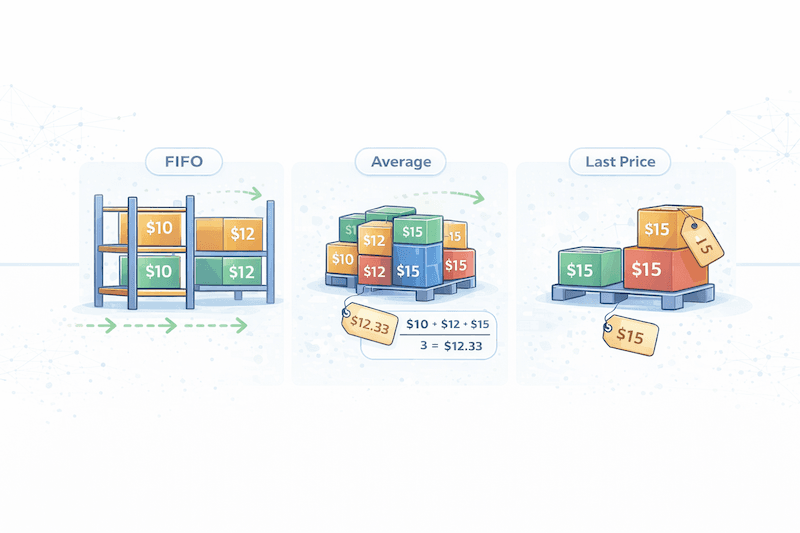
FIFO, short for First In, First Out, means the oldest units leave stock before the newer ones. Without that discipline, older stock sits while newer lots are used first. That creates expiration risk, cost distortions, and difficulty reconciling what physically happened against what the system says.
Applying FIFO consistently requires the system to know when each unit was received and which layer should be used next. A process that does not record receipt dates or that pulls from any available lot without order makes FIFO practically impossible to enforce. The FIFO inventory logic depends on the same event discipline that prevents other stock discrepancies.
FIFO is the clearest example of lot discipline and stock rotation. Some businesses value inventory with weighted average cost or last purchase price instead, but the operational requirement stays the same: receipts, layers, and stock events need to be recorded consistently.
7. Adjustments without explanation
Every business needs a way to correct inventory. Physical counts catch discrepancies. Damage happens. Errors in receiving are discovered later. The problem is when adjustments become a routine correction method with no context attached.
When someone can change the balance without recording why, the business loses the audit trail. The same error returns, now disguised as a new discrepancy, and nobody can connect it to the previous correction. A good inventory audit trail turns adjustments into a learning tool. Instead of hiding problems, it reveals patterns and helps prevent them from repeating.
8. Disconnected tools
When receiving happens in one spreadsheet, purchasing in another, and production in a notebook on the factory floor, inventory lives in multiple places that are never quite in sync. Each team manages its piece, and the handoffs between them become sources of delay and inconsistency.
Inventory accuracy is a cross-functional problem. It involves purchasing, receiving, warehouse, production, and sales, often on the same day. Tools that do not talk to each other cannot produce a reliable shared picture. Warehouse management runs much more predictably when it operates from the same inventory record as procurement and production.
9. Counting as the only control
Periodic stock counts are useful. They verify whether the process is working and catch gaps that operations might have missed. What they cannot do is explain how a discrepancy happened or prevent the next one from forming before the following count.
If counting is the main method for keeping inventory accurate, the business is permanently behind. Errors accumulate silently between counts, and the reconciliation process only removes them in batches. Teams trying to prevent stock mismatch need counts to validate the process, not replace it.
10. No production consumption tracking
For businesses that manufacture, assemble, or process materials, production consumption is one of the highest-frequency inventory events. Every batch that runs should reduce raw material stock and increase finished goods or work-in-progress.
When that consumption is not tracked in real time, or is estimated rather than recorded, stock diverges fast. Materials disappear from the system later than they were used, variance between expected and actual consumption stays hidden, and costs are calculated from incomplete data. Production management that records consumption at the moment it happens keeps inventory and cost in sync.
How to build a more reliable inventory process
Preventing inventory errors is not about working harder. It is about building a process where errors are harder to make and easier to detect when they happen.
Five practical rules help:
Move closer to real-time. Every hour between a stock movement and its recording creates a window for silent error. The goal is not instant perfection. The goal is shrinking that window.
Separate intentions from executions. Purchase orders, sales orders, and production plans communicate what should happen. Receipts, shipments, transfers, and consumption records document what did happen. These two layers should never be confused.
Make stock states explicit. Available, reserved, in transit, blocked: if all stock looks the same, the operation will make decisions it later has to reverse.
Record adjustments with reason. Corrections are part of operations. They should carry context, not just a new number.
Use one connected record. If the receiving team, the warehouse team, and the production team work from different tools, inventory accuracy will always depend on manual synchronization. That is a fragile basis for any planning.
What modern inventory systems do differently
All of these errors share the same root cause: the system does not accurately reflect real-world events. When inventory is treated as an editable number instead of the result of recorded actions, inconsistencies are inevitable.
Modern inventory management software is built around event records, not editable balances. Each receipt, reservation, transfer, consumption, and adjustment creates a traceable record that updates stock automatically and consistently.
That approach does not eliminate exceptions. It makes exceptions easier to find, investigate, and resolve because the context is preserved. You can see what happened, in what order, and why. That is the foundation for less recurring error and faster operational improvement.
Event-driven inventory shifts the question from "why is this wrong?" to "at which event did expected and actual diverge?" That shift changes how teams respond to discrepancies: from guessing and correcting to diagnosing and improving. If you want more context on why that matters structurally, Why Inventory Never Matches (And How to Fix It) covers the root causes in detail.
Inventory errors stop being a mystery when the process leaves a trail
Inventory errors usually grow out of small gaps that repeat every week: late updates, missing stock states, undocumented corrections, and disconnected tools. Those gaps are hard to spot early and easy to normalize.
Loribase was built to make that kind of divergence visible. Receiving, transfers, production consumption, and adjustments all leave a traceable event in the same operational record. Control comes from process clarity, not repeated manual correction.
If your team is recounting the same SKU more than once a month, the next step is not another recount. Start a 14-day free trial and see what a process built around events instead of editable balances looks like in practice.